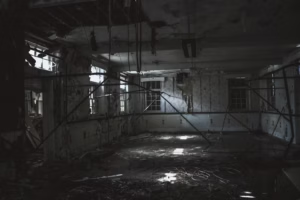
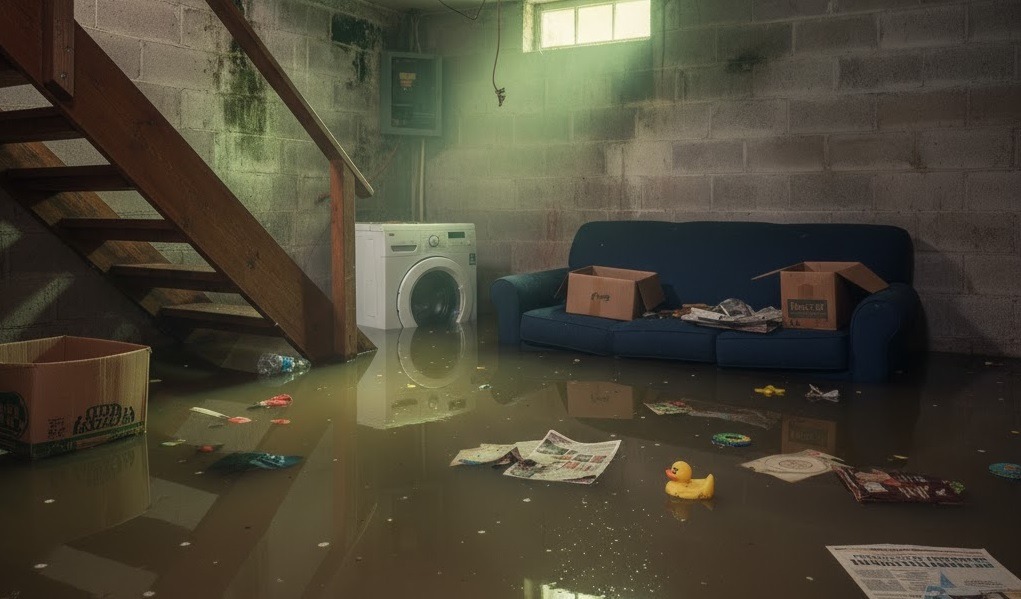
The wall cracks, the lights flicker, the furniture is broken, and there’s an overall sense of disrepair. Nothing is more horrific than walking into a damaged or flooded basement.
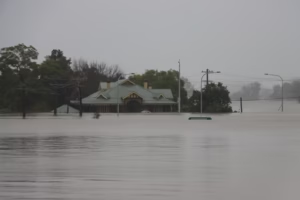
With climate change causing catastrophic rains that cause floods, and due to the qualities of the soil of the state, a damaged basement is one of the most prominent problems in New York City.
Hence, basement water damage repair services have become a basic necessity for homeowners.
In this article, we will explore what causes basement water damage, what to do when the damage occurs, how professional companies handle it, a DIY process, and the total costs you can expect.
Key Takeaways
- The first step is to ensure safety by cutting off the electricity and water supply to the affected area.
- There are three categories of water. Clean (Category 1), Gray (Category 2), or Black (Category 3). Do not touch Category 2 or 3 (sewage/ flood water).
- Mold begins growing in 24–48 hours. Quick action is essential to prevent costly mold remediation.
- DIY is suitable for minor, clean water leaks, but professional services are necessary and safer for gray or black water.
What causes basement water damage in New York City?
There can be multiple reasons behind water damage, especially in New York properties, such as:
- Heavy rainfall: Due to the climate crisis, rains that flood New York are becoming more and more common.
- Hydrostatic pressure: The soil quality in some areas of New York City is rich in clay or has a clayey texture. Hence, if saturated, it shrinks and puts constant pressure on the foundation walls. This often causes stair-step cracks or bowing walls.
- Poor exterior drainage: If sidewalks or patios around your house slope toward your foundation instead of away from it, rainwater may pool, causing a flooded basement.
- Combined sewer overflows (CSOs): 60% of NYC uses a combined sewer system. During heavy rain, this system can exceed capacity and overflow, causing sewage and stormwater to back up into basements.
- Sump pump failure: Most homes in NYC with basements have a sump pump. If it fails, accumulated water will quickly rise and flood the space.
- Foundation cracks: New York’s air is humid. This can cause the concrete walls to crack, leading to leakage and eventually a flooded basement.
What to do when your basement is damaged by water?
Fixing gutters or filling out cracks in the concrete walls can definitely help against a water-damaged basement. But sometimes, the condition seems completely out of control. Here’s what to do if you find yourself in such a situation.
Assess the situation
First and foremost, do not panic, and calmly assess the situation. Look for the water condition and check the water quality, as in:
Category 1: White water
This water comes from a clean source and does not pose an immediate health risk, but it can quickly become dirty if left untreated.
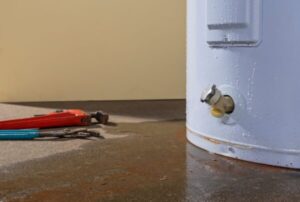
It comes from a burst pipe from a clean water line, a water heater, a clean appliance leak, or rainwater coming through a clean window well.
This is the easiest to clean up, but quick action is still necessary, as clean water turns to gray water within 48 hours.
Category 2: Gray water
This water contains some level of contamination (chemical, biological, or physical). It is considered dirty and can make you sick if you swallow it.
It can come from a dishwasher, washing machine, or a toilet overflow. It does not contain any human waste or seepage through the foundation walls.
Before touching this kind of water, you should wear protective gear (gloves, boots, etc.). Everything the water touches (like drywall or insulation) will usually need to be dried, disinfected, or removed by professionals.
Category 3: Black water
This water is highly contaminated and is filled with harmful bacteria, viruses, and disease-causing pathogens. It is the most dangerous kind of floodwater.
It usually comes off sewage backup, flooding from rivers or seas, or water from a toilet that contains human waste.
Do not touch this water! It requires professional remediation, specialized protective gear, and expert disinfection. Everything porous (wood, carpet, furniture) that touches black water must be safely removed and properly disposed of.
Cut the electricity and water supply
Next, cut off the electricity and water supply to the basement. However, it’s important to note that this does not apply if you would require contact with the water for doing so.
In that case, call your electric company and ask them to cut the power to your house.
Similarly, if you can reach the main valve, close it to stop the flow and prevent further flooding. Otherwise, call the water company and ask them to shut off your water supply.
Call a basement repair company
After cutting the electricity and stopping the water flow, immediately call a basement water damage repair company. You can easily find one by looking up “basement water damage repair near me.”
In New York City, you can call Perfect Restoration and Cleaning. Our team of experts arrives in less than 60 minutes. They are equipped with all the necessary tools to restore your basement and make it better than before.
Dos and don’ts of basement water damage repair
Standing water harbors harmful diseases. Ingesting category 2 or 3 water can be extremely dangerous or even fatal in some cases. Hence, it’s important to understand what to and what not to do:
Dos
- Act quickly. Mold can grow within 24 to 48 hours. Immediately call for Perfect Restoration and Cleaning services, and let us take care of your basement.
- Document the damage. Take pictures and record videos as proof of damage for insurance companies. It is important to contact your agent immediately to understand what your policy covers.
Don’ts
- Don’t touch standing water. Regardless of how tempting it is to save your favorite carpet or favorite piece of decoration from water damage.
- Don’t try to DIY if the water is category 2 or 3. Dealing with water category level 2-3 requires experts and proper safety kits.
How to repair basement water damage yourself (DIY)
If it’s clean water and less in quantity, you can do it yourself as well. Here’s how to do it:
Assess the extent of damage
Identify the water source and water type (clean, gray, black) and check for structural issues, mold growth, or damaged insulation. Look for any furniture or porous material that can retain water.
Remove standing water
Use mops and buckets, towels, and thick clothes to remove standing water. Later, mop the floor and walls again until the room is completely clear of standing water.
Dry the area of moisture
As discussed, mold can form in as little as 24 hours. Keeping that in mind, dry the area of moisture using air conditioners or open the windows to allow ventilation.
Repair structural damage
Use hydraulic cement or waterproof patch products to fill small cracks in the walls or floor where water is entering.
Sanitize and mold prevention
Disinfect with a bleach solution or EPA-approved product. For lasting defense, choose a product specifically registered to kill fungi.
Professional basement water damage repair services
After your call, once we reach there in less than 60 minutes, here’s what happens:
Water extraction
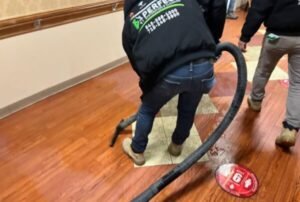
We use submersible pumps and wet/dry vacuums to extract the standing water from your basement.
Structural repair and restoration
Next, we look for any structural damage. If there is something that needs repairing, we repair and restore it to make it better than before.
Mold remediation
Mold can be injurious to the health of your loved ones living in your house. It can cause allergic reactions, respiratory problems, and infections. Therefore, we use air scrubbers to eliminate every last trace of visible mold.
Finally, we use thermal imaging to ensure there isn’t any mold that can’t be seen with the naked eye.
Deodorization and deep cleaning
Last but not least come deodorization and final touchups. This is another essential part of a basement flooding water removal process. We use disinfectants and steam distillation for the process.
After contemplating this seemingly long process, you might be thinking that a flooded basement repair may cost a fortune. But it doesn’t have to. Let’s check out the estimations in the next section.
Basement water damage repair cost
Water damage basement repair costs vary greatly based on water type and the severity of damage. Overall, the average cost is between $3,000 and $7,000.
- Minor clean water intrusion: Expect costs between $500 and $2,000 for simple water removal and drying.
- Moderate damage with gray water: Mid-range costs are typically $3,000 to $8,000, covering disinfection and minor reconstruction.
- Severe structural damage: High-end repairs, involving sewage cleanup and major structural replacement, can go up to $25,000.
Professional services not only offer guaranteed cleanup, but might also be the cost-savvy option. That’s because doing it yourself may cost more, considering the rental prices of heavy machinery and the long-term costs of unmitigated damage.
Transform your water-damaged basement with Perfect Restoration & Cleaning
Your water-damaged basement deserves the best care, and our team promises nothing less than that. Hand over the complete flooded basement damage restoration process to us, from water removal to insurance claim processing, and wait for your basement to become better than before.